Thursday, February 20, 2014

John Wallace of Gallia County, Ohio


Finding the parents of a female ancestor can be and often is a struggle. We need to look at all kinds of sources to get clues. Come with me down this rabbit hole. Nancy A Browning’s daughter named her mother’s parents as James Browning and Bettie Wallace on the death certificate. Searching for James and Bettie, I found a marriage record for James Browning and Elizabeth Wallace in Jackson County, Ohio dated 23 Dec 1838. Following this clue, I discovered them on the 1840 US census living as a couple in Jefferson Twp, Jackson county, OH. They were living next door to Archibald and Elijah Browning. All three men were similar in age; perhaps they were brothers. In the 1850 census, James and Bettie are living in the same township but now next door to an Andrew Wallace family that includes a John Wallace age 75. Could this be Bettie’s brother and father?  The ages make sense.

Let’s look at this John Wallace more closely. Through land records, I found a John Wallace of Gallia County who patented 38.37 acres of land in Jackson County in 1832 and 2 more parcels of 40 acres and 55.63 acres in 1836.  (Ohio River Survey, Congressional Lands, Jackson Co, Ohio) Andrew Wallace appears to be living on one of these parcels.

Stepping back to Gallia county, there was a John Wallace living in Greenfield Township in the 1820 and 1830 census. (Gallia County, Ohio Residents, 1800-1825, complied by Dennis R. Jones)  He also paid chattel tax there. A Martha Wallace married Elijah Browning in Gallia County in 1831. Brothers marrying sister is not uncommon. According to subsequent census Martha Wallace Browning was born in VA. This could have been in what is now WV. Elizabeth (Bettie) was born in Ohio in 1815. So, assuming these women were sisters who married brothers, sometime between 1812 and 1815 John Wallace moved to Ohio from PA or VA.

While I have not found the answers yet, it appears this family is intertwined. There are many John Wallaces in Ohio at this time, but only one family in Jackson and Gallia counties. Many people have this John Wallace confused with the John Wallace from Indiana County, PA. They are not the same. 


Monday, July 29, 2013

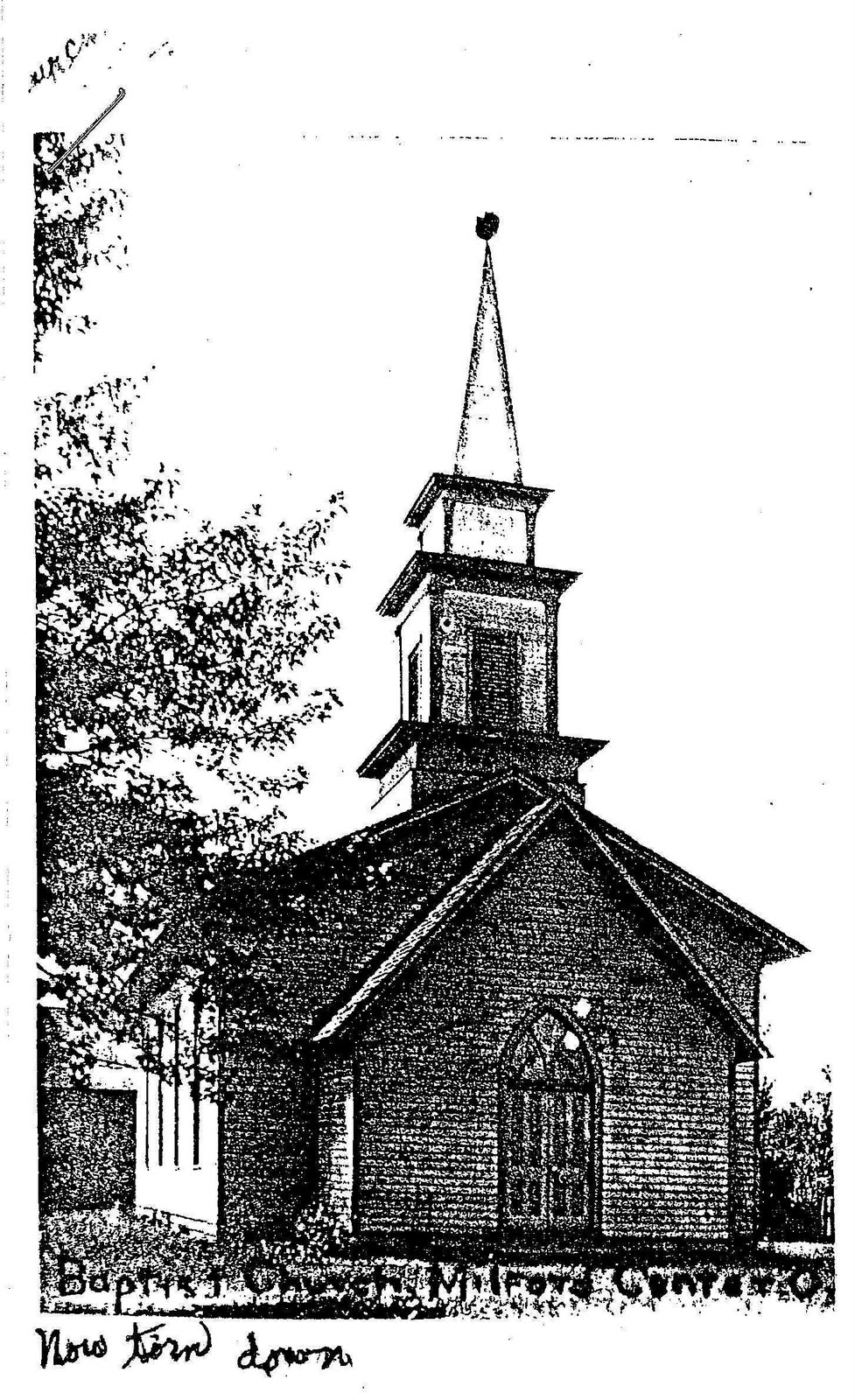
The First Baptist Church of Milford Center

The First Baptist Church of Milford Center was organized May 12, 1855, with the following constituent members: Elijah Witter and wife, Joseph Halteman and wife, John S. Fulton and wife, Lucy A. Lucas, Horace Andrews and Thomas Andrews, with Elijah Witter as Deacon, and Joseph Halteman as Clerk. Trustees, Elijah Witter, James Simpson, Joseph Halteman and Horace Andrews. The following have been pastors of the church: Revs. James Simpson, A.J. Wyant, H.H. Witter, Gray D. Bryant, John Wright, H.H. Dunaway, W.N. Bean, and Rev. H.P. Clark who is the present Minister.

W. H. Beers, The History of Union County, Ohio. Vol. 2, Pt. 1 p. 188


Monday, December 26, 2011

Best Friends since 1906

My grandfather, Casey Robertson's best friend was Paul Kile. I knew him as an old man who wore bib overalls, gave us Juicy Fruit gum and drank coffee with my GrandDad every morning. He teased my sister mercilessly about her name. He never married and lived with his sister on the homestead. While going through old pictures with Aunt Betty a few days ago, I found this photo of District school #7 in Essex, Ohio, in 1906 and, there in the front, standing next to Casey was Paul.

Back row - Ethelwyn Mather, Lizzie Wollring, Ella Columber, Lura Carter, Florence Kile, Effie Judd, Charlie Blue, Sherman Chapman, Jay Streeter, Hort Columber

Front row - Edith Chapman, Martha Robertson, Cecil Carter, Faune Carter, Iris Carter, Lucille, Young, unbknown, Emily Kile, Irene Columber, Sherwood Chapman, Cloyce Moore, Nelle Young, Clarence (Casey) Robertson, Paul Kile

Sunday, September 11, 2011

Stop the Car!

Do you see what I see? While out birding in Orange County, NY, today I was stunned to find a zebra in the same field as a herd of donkeys and mules. His camouflage is not working so well in a field of field flowers and NY autumn grasses.

Thursday, September 1, 2011

The tale of two Fannies

There was no way around the fact that the records were sealed. In perpetuity. Like forever. Without a court order, there was absolutely no way to get to them. The Probate Court clerks would not even provide a date range so we could figure out if the records were even related to, Frances (Fannie) Dixon, the Great, Great, Great, Great Grandmother in question. There was only one whispered hint. They were usually sealed for reasons of adoption or insanity. Well, we knew it wasn't adoption. She arrived from Virginia as a married woman.

I sat at the dining room table drumming my fingers and pondering the options. Fannie died in 1863 at 63 years old. She was in the census in 1860. It didn't make sense that she would have been committed because she died just 3 years later, safely in her bed.

I went back to the drawing board, frustrated. Well, OK, let's then revisit the last census she was in. For the first time, I noticed that they had a girl, named Fannie, living with them who was 22. That would have made her mother over 40 when she had her. Not all that unusual. But, what if the girl had Down's Syndrome, Cerebral Palsy or some birth defect. In the 1870 census, Grandma Fannie's husband John is living with their son, John Jr., no daughter Fannie to be found.

Working under the assumption that the girl had some sort of issues and lived at home until the mother died, then the father and brother could not or would not handle her, I took a chance, and checked the 1870 census to see if she might have been a resident at the local Infirmary. Bingo. There she was. She was also there in 1880.

Since my sister has a copy of the Infirmary records, I called her; and sure enough Fannie Dixon was placed in the Infirmary in 1867. So, her family did try to manage her for four years. BUT also in those records, was her being transferred to the State Hospital in 1888 at the age of 50. The State Hospital was the Insane Asylum.

While I do not know what Fannie's diagnosis was, I now believe that the sealed records at the Probate Court are where her family had her committed. Perhaps her condition deteriorated or she grew violent as she aged. There is no 1890 census to look at and I am not even sure if the residents of the State Hospital were enumerated in any census.

Have you found sealed records in your search? Were you able to work around them?

Saturday, July 16, 2011

Cyber Granny

We bought my mother an iPad for her 80th birthday and not only is she devouring ebooks, but blasting through levels of games (Angry Birds and Cut the Rope) way beyond me. (OK, I just discovered the spiders in Cut the Rope that she has been going on about.) Now when I go home, we swap iPads and I take hers when I go out and she reads all my new books. This is seriously the gift that keeps on giving. I highly recommend that you consider this. With it's touch screen, it is intuitive and easy for those with arthritis to use. Now at gift-giving time we replenish her iTunes and Amazon/Kindle accounts. What could be easier? I have since chatted with many friends who have done the same thing with equal success. I can't say it has changed her life, but she does love it.

Friday, July 15, 2011

Perennials for Old Ancestors


Many, many years ago, (mmm, maybe, oh heavens, maybe 20) my aunt Betty and I planted daisies at the grave of Martha Holmes Romick Schertzer, one of my ancestors on her side of the family. I am not sure if those daisies are there any longer, (deer would be my guess) but I still love the idea of perennials for old, out of the way stones from long ago ancestors. I have been talking about doing it again for some time. Since I'm here in Ohio for my Mom's birthday, I cajoled my sister into digging up some perennials from her backyard to take over to Mitchell cemetery, one of the oldest in the county. On, may I add, the afternoon on one of the hottest days. Many of my mother's early ancestors (Browns and Patches) are buried there.

There were Black-eyed Susans for Susannah Brown (1834-1895). Heh. Appropriate, no?

And Coneflowers for her husband, Isaiah (1829-1896)

Our more distant ancestors are buried in the old section of the cemetery.

Rosanna Maus Brown, (1747-1832) the wife of Adam Brown, was the matriarch of the clan. In about 1831 or so, (at age 84) she made the rugged cross-country wagon trip with her youngest son Christopher and his family.

Her eldest son Windle (1768-1850) and his wife, Amelia Wilson (1773-1853) followed in 1834. Sometimes the choice of flowers was about the size of the plant rather then about any significance. Windle's stone is short while Amelia's is tall.

I cannot even imagine when flowers might have been planted for them last.

Sunday, July 3, 2011

Gravestone angels

I was walking through the old section of Warwick Cemetery when I across this stone. What a frowny face. I wonder if the carver knew the man. Look at the wig, jowls and tie. He looks decidedly unhappy about his fate.


This curly-haired angel on the other hand looks positively rapturous. Or, at least she is smiling.

The same carver did this one and this angel looks worried to me, as if he were not sure of his fate. I wonder if the family had any say in the type of angel that got carved-whether they were smiling or not. I do like these better than the winged skulls though.

Saturday, May 14, 2011

Ash Borer Survey


From the corner of my eye, I noticed a purple box hanging from a tree. I was past it before I could do more than turn my head. My first thought was that the kids were up to something. Then I saw another one. This time I pulled over to see what was going on.

The USDA is doing an Emerald Ash Borer Survey in 48 states. The purple boxes are really 3-dimensional plastic triangular traps. Apparently Ash Borer groove on the color purple. The traps are baited with Manuke oil. The adults fly around and if they land on the trap they will get stuck. The traps will be monitored during the Spring and Summer and removed in the Fall.

Having the traps doesn't mean we have the offending beetle, but they are looking for it. The goal is to define the boundaries of infested areas.

If you see one of the traps on the ground, call the EAB hotline at 866-322-4512 and remember don't move firewood. Burn it where you buy it.

Thursday, May 12, 2011

Smitten with Borage

I was completely smitten with borage while at my sister's house last year. It had lovely blue star-shaped flowers and was covered in hairs. I had visions of the local herd of deer munching along and getting a mouthful of icky hairy leaves. Take that, you eating machine. But I can't find it anywhere in any of the local nurseries. I'm now going to try and grow it from seed. If I can find the seed.

Sunday, May 1, 2011

Hooded Merganser Babies

While photographing waterlilies in the tea brown waters of the swamp, the leaves riffling gentling in the breeze, the silence broken only by the the song of Red-winged Blackbirds; an agitated jerking of distant leaves and the hint of ripples in the water revealed a duckling, then 2. Looking ahead of the stragglers, I saw a mama Hooded Merganser push through the hidden passages with a flotilla of 10 babies following in her wake.


Hooded Mergansers are cavity nesters in swampy areas. Given how many Wood Duck boxes are scattered around the Great Swamp, I am sure she appropriated one.

Saturday, April 30, 2011

Highbush Blueberry

I was meandering down the elevated boardwalk through the Great Swamp struck by all the tiny twinkling wildflowers just emerging from their long winter's nap; when I came across a tall woody shrub with pendulous urns. The shrub was at least 6 feet tall. Remembering that Teaberry had flowers similar to this, I happily hummed the old Teaberry gum jingle all the way back to the car.

Imagine my surprise when I got home to see that Teaberry is low and in the wintergreen family. Definitely not a 6 foot shrub. It turns out this is a Highbush Blueberry and can grow up to 15 feet. That is a lot of blueberries! Our cultivated blueberries are derived from this shrub.

I have wild Blueberries up here on the mountain, but they are at best knee high. I wonder if they will grow up to be this?

Sunday, April 17, 2011

Met and Married on the Same Day or Not

The oldest son of Joseph Temple, Sen., was born May 6, 1827, in Adams County, Ohio. His parents moved to Jackson township when he was fifteen years of age. He remained at home with his parents until over age, clearing, making rails and building fence being his principal occupations.

July 6, 1849 he was married to Lucy A. Andrews, 23, who was then teaching school in Arbela. Her parents, Horace and Azubah Andrews, resided near Marysville and she borrowed a horse of one of the school directors, ostensibly to pay a visit home. He, not wishing her to travel so far unprovided with an escort and, not knowing that she was already supplied, asked Mr. Temple to accompany her. Of course the modest Joseph meekly acquiesced; and early Friday morning they stared for Marysville, well mounted. A heavy shower delayed them and the hour for dinner found them on the bank of Blue Creek. Halting before the door if a rude log cabin, they inquired for dinner and were invited to dismount. They were treated to an antenuptial feast of corn bread, speck and onions. Arriving at Marysville, they repaired to the residence of Esq. Jas Turner and were there married, when in Mr. Temple's own language, "we got on our horses and went on our way rejoicing."

Sunday they returned, she to the school room and he to the harvest field.

When her school closed Mr. Temple rented his grand-mother's farm and they went to housekeeping in the rude log house yet standing near his present residence, a memento of those early happy days.

Memories & Sketches, Civil War Era, Northern Union County, Ohio, Ancestrails Study Group, 2000, p. 98. Material taken from the Richwood Gazette, 1890s.

This begs but also answers some questions.

Was Joseph and Lucy Ann courting prior to the ride? This sketch seems to suggest that might be the case, OR did she meet and marry Joseph all in the matter of a few hours. If so, for a modest man, he must have been a smooth talker.

Lucy Ann Andrews was my Great, Great, Great Aunt, sister to John Morris Andrews. I found Azubah Andrews, their mother, in the 1860 census living with her Grandson Horace on the Temple farm. Her son, John Morris Andrews, while living in the same township was not closeby. While trying to figure out the Temple connection and how Azubah could be living on the same farm, yet in a separate household, I stumbled across the fact the her daughter, Lucy Ann married a Temple. After reading this sketch, it now makes sense since there was a separate cabin. While there still are questions, small locally published booklets can provide clues to how our ancestor's lived.


Thursday, April 14, 2011

Owlet


I got out of my car in the parking lot at work to the hooting call of a Great Horned Owl. It was 10 AM. I knew that they nested in February and that they often took over old Red-tailed Hawk nests. I walked to the top of the lot, straining to discern anything out of the ordinary in the last year's nest. What might have been something was probably a twig. I shrugged and went in out of the biting cold. I didn't have my binoculars with me.

Several days later, I remember my bins and browsed the nest again and lo and behold there were two tell-tale tufts rising above the edge of the nest. I snapped a photo and danced into the office camera in hand. (I do love digital camera.) "Lookee, what I found!"

Well here we are 2 months later and junior is starting to spend time alone (with mama a few trees away.) Can you see him? He is the giant grey puffball sitting on the right of the nest. Try double-clicking on the photo and it should open up in a large window.

Wednesday, April 13, 2011

Civil War Letter on the Loss of George Holmes


Oct the 17th, 1863

Camp near Chattanooga, Tenn

Dear father and mother,

It is with the greatest of pleasure that I sit down to inform you that I am well at present and I hope you are all the same. I would write sooner but it is been so I could not write and it is so hard to content my mind long enough to write. It is lonesome here to me. You want to know all about George. I will tell you the best I can about him.

On the 20th of Sept about three o'clock we went in the fight and about four o'clock he was shot and I fell back to hunt him. I hunted about one hour and I found him and I ran and found a blanket to spread over him and I tried to git somebody to help me to bear him away but I could not get anybody to help and our men was a falling back and I had to leave him and the rebels got him and had him ten days and they fetch him to the lines and our men went after them and I found him the first day of Oct and was with him til he died. He died on the 10th of Oct a Saturday and was buried the 11th at five o'clock. He still thought that he would get well til about 24 hours before he died and he told me that he was not a going to ever see home again. That was awful sad to me. I asked him if he wanted to be took home and be buried at home and he said he wanted to be buried in that graveyard to the chapel. The night before he died he told me to go and tell the steward to come and pray with him and I went and told the steward and he came and prayed with him. Poor George prayed for his self. He was in so much misery he could not hardly pray but he prayed. I never was in such a fix in my life. It seemed to me I had no friends in the world of a night that would come and tell me he was a dying and I could not get to sleep for I was pretty near sick myself. I was up with him so much I could not sleep when I would lay down. He thought he would get well enough to go home in three weeks. He said he was a going to go to Nashville, telegraph to father to come after him. He told me to go and see Mitchell and get him for father and to hurry back and I started and I was gone but a little while and when I got back he was dead. He said that maybe father could get here before he died. He said that he called for father and said he was a sailing in a ship. Was the last words he said. I have got his clothes but I don't expect I can get to send them home. I haven't seen any chance yet. If I can get his coat and belt and sash home I don't care so much about the rest for the rebels took his money and all the other things they could find. I will have to close my letter this time. I want you to write some and often to me and let me know what you was doing the 10th and a Sunday in the afternoon. I will close my letter so goodbye from

William H Holmes

To his parents
Nimrod and Frances Holmes

George W Holmes (28 Apr 1841 - 10 Oct 1863)
1st Lt. Co. C. 113 Reg. O.V.I.

William H. Holmes (1843-1906)
Corporal Co. H. 113 Reg. O.V.I

As you can see his parents did put up a monument for George at the graveyard at the chapel as he wished. His stone is at Wesley Chapel Cemetery in Hilliard, Franklin County, Ohio.

George and William Holmes were elder brothers to my Great, Great Grandmother Martha Holmes Romick

Monday, April 11, 2011

Patch Boys in the Civil War

Harmon Patch Jr, 1845-1922 Co. I, 121st Ohio Infantry; Co. H. Veterans Reserve Corps, 15 Infantry Regiment. He enlisted at 17.


My Great, Great Grandfather James W. Patch was born in May 1856, the youngest of 10 children. In April of 1861, when the war broke out, he was 4. While he stayed home, three of his elder brothers enlisted:
Esley, Co. G., 17th Ohio, Apr-Aug, 1861; Co. I 121st Ohio, Sept 62-Jun 65.
Alemuel, Co. D. Regular Army, 1862-1864,
Harmon Jr. Co I 121st Ohio, Sep 62-Dec 64.

All three brothers made it through the war. Although Alemuel was admitted into the National Home for Disabled Soldiers in Dayton Ohio at the age of 52, then transferred to the Home in Marion, Indiana, where he died. I have frankly wondered about what we now call PTSD. All three of these men suffered for the rest of their lives.

Harmon Patch Sr. felt strongly about the war. This is from his obit.

[Harmon] was a patriot in the dark days of the rebellion. He not only gave of his means to clear his township from draft but gave three sons and one son-in-law to put down that rebellion to preserve the union and uphold the flag. Politically he was an Abolitionist before there was an Abolitionist, believing that slavery as it existed in the South was not only a great injustice to the negro, but also a disgrace to our nation and sin before God."

Marysville Tribune 26 August 1896 P4 c2